

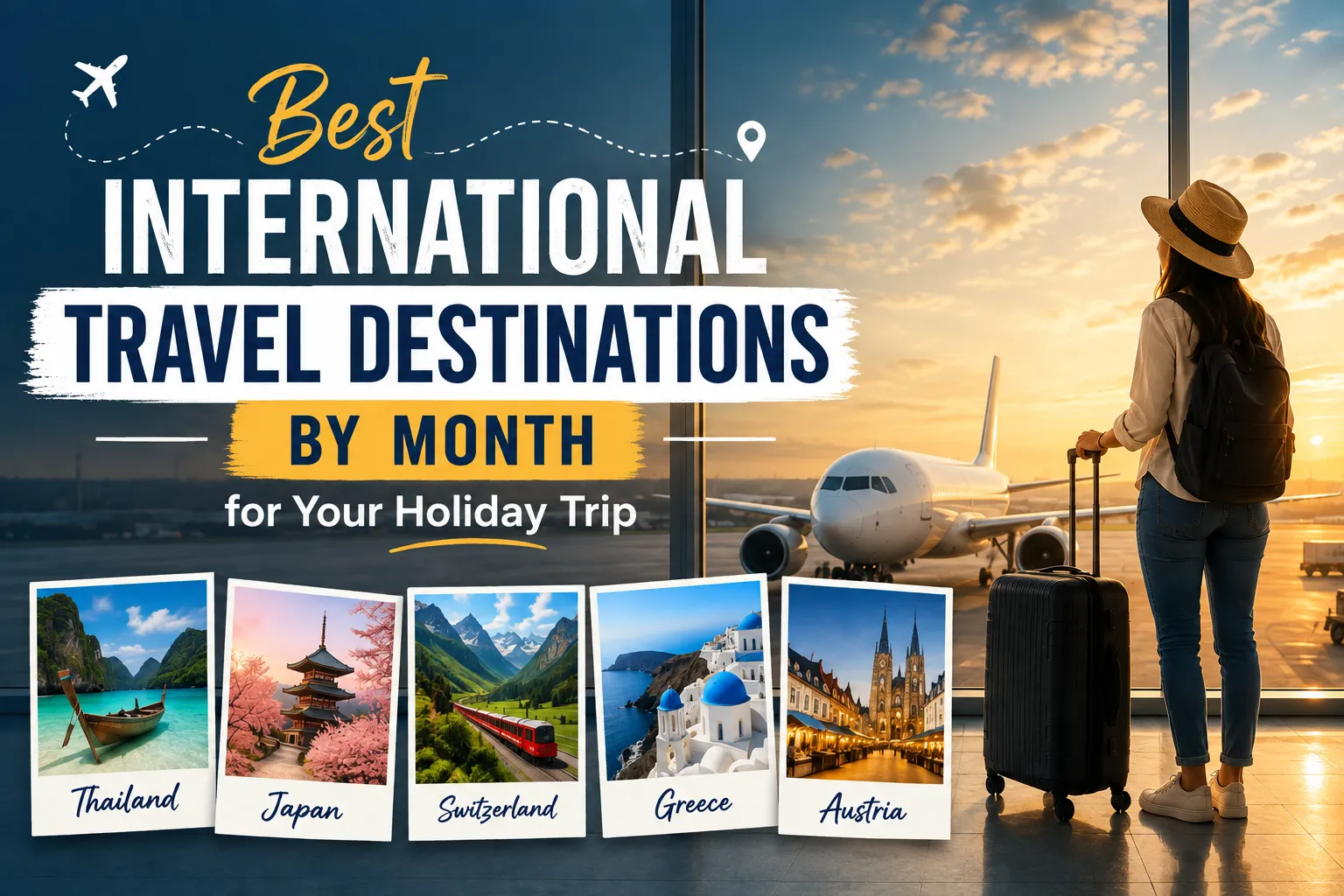
There is no single “best” country to visit at all times of the year. A destination that is perfect in January may be rainy, unbearably hot, crowded, or simply less rewarding six months later.
That is why experienced travelers often choose International Travel Destinations by season rather than choosing a country first and checking the weather afterward.
January can give you sunny beaches and comfortable sightseeing in Thailand. March brings the first wave of Japan’s cherry blossom season. June opens up Switzerland’s alpine landscapes, while August can put you in Kenya during one of the most exciting wildlife periods of the year. By December, Austria’s historic cities have transformed for Advent and Christmas.
This month-by-month guide explains where to travel, why that month works, what kind of experience to expect, and what you should know before booking.
Best International Destinations by Month at a Glance
| | |
January | Thailand | Beaches, food, temples and winter sun |
February | Vietnam | Culture, food, scenery and comfortable exploration |
March | Japan | Cherry blossoms, cities and culture |
April | Netherlands | Tulip fields and European spring |
May | Italy | History, food and pleasant sightseeing weather |
June | Switzerland | Mountains, hiking, lakes and scenic rail journeys |
July | Iceland | Road trips, nature and long summer daylight |
August | Kenya | Safari and the Great Migration season |
September | Greece | Islands, warm sea and fewer peak-summer crowds |
October | South Korea | Autumn foliage, food and cultural sightseeing |
November | Malaysia | Tropical islands, cities and regional variety |
December | Austria | Christmas markets, winter cities and alpine atmosphere |
January to March: Winter Sun, Culture and the Arrival of Spring
January: Thailand for Beaches, Temples and Cooler Weather
January is one of the easiest months in which to experience several sides of Thailand on one trip.
Thailand’s official tourism authority describes January as one of the coolest periods of the year, particularly in the northern and northeastern regions. Even Bangkok generally feels more comfortable for long sightseeing days than it does during the hotter part of the year.
That makes January a good time to combine several different experiences.
Spend a few days exploring Bangkok's temples, markets and neighbourhoods before travelling north towards Chiang Mai or Chiang Rai. If beaches are your priority, southern Thailand gives you options ranging from lively resort areas to quieter islands.
Northern mornings and evenings can feel surprisingly cool, especially in mountainous areas, so packing only tropical beachwear is a mistake.
Best experiences in January:
Bangkok's temples and street-food neighbourhoods
Chiang Mai and northern Thailand
Southern beaches and islands
Outdoor markets and cultural sightseeing
Island-hopping and water activities where local sea conditions permit
For seasonal information, check the official Tourism Authority of Thailand.
Planning tip: January is popular for good reason. Flights and accommodation in major beach destinations can be expensive around New Year and other busy travel periods, so flexibility with your dates can make a meaningful difference to the budget.
February: Vietnam for Food, Culture and Regional Variety
Vietnam cannot be treated as one weather zone.
The north, centre, highlands and south can experience very different conditions at the same time, which means choosing your route is just as important as choosing your month.
February is particularly attractive if you want to explore Vietnam's cultural side. Vietnam's official tourism website highlights February in Da Lat for its spring atmosphere, flowering landscapes, cool air and particularly clear skies. Central destinations also begin moving into a more favourable part of the year, although local conditions still vary.
A first trip could combine Hanoi, Ha Long Bay, Hoi An or Hue, and Ho Chi Minh City, depending on the number of days available.
Food is another reason February works so well. Rather than treating meals as something between sightseeing stops, build part of the itinerary around local markets, Vietnamese coffee, regional noodle dishes and evening street-food areas.
February may also coincide with Tet, the Vietnamese Lunar New Year, depending on the year. That can add enormous cultural interest, but it can also affect opening hours and domestic transportation.
Before choosing cities, review the regional climate information on the official Vietnam Tourism website.
Planning tip: Check your exact travel dates against Tet before finalising domestic flights, trains and sightseeing plans.
March: Japan for the Beginning of Cherry Blossom Season
Few seasonal travel experiences generate as much excitement as Japan's cherry blossoms.
March is when the sakura season starts becoming a major part of travel planning. The Japan National Tourism Organization explains that cherry blossoms begin appearing in warmer parts of the country before the flowering front gradually moves north. Tokyo commonly begins seeing blossoms toward late March, although timing changes every year.
Tokyo's Ueno Park, for example, is famous for its large concentration of cherry trees, with the main viewing period often falling around late March and early April.
A classic first-time itinerary might connect:
Tokyo → Hakone or Mount Fuji area → Kyoto → Osaka
But cherry blossoms should not be your only reason for visiting. March also offers temples, neighbourhood exploration, regional cuisine, rail travel and seasonal cultural experiences.
Travelers researching a Japan Tour Package for Couples should pay particular attention to dates rather than simply choosing “March.” A trip in early March can look completely different from one beginning during the final week of the month.
Use the official Japan cherry blossom forecast as your trip approaches rather than relying on last year's dates.
Planning tip: Sakura dates are a natural event, not a guaranteed appointment. Avoid constructing an entire holiday around one predicted day of peak bloom.
April to June: Flowers, European Spring and Alpine Scenery
April: Netherlands for Tulip Season
If you have ever seen photographs of enormous Dutch fields covered in stripes of red, yellow, pink and purple, April is the month most closely associated with seeing them in person.
The Netherlands' official tourism site explains that the broader flower season stretches from spring into May, with tulips generally showing their strongest colours from around mid-April into early May.
The Bollenstreek flower-growing region between Haarlem and Leiden is one of the country's best-known areas for spring flowers. Keukenhof, near Lisse, also becomes a major attraction during its limited annual opening season.
But do not make the mistake of seeing only Amsterdam and Keukenhof.
Consider combining Amsterdam's canals and museums with Leiden, Haarlem, The Hague or a cycling route through the flower-growing region.
The official Netherlands tourism website provides useful seasonal information.
Planning tip: Spring weather can change quickly. Carry a compact waterproof jacket and plan at least one flexible day in case the weather is better for the flower fields later in your stay.
May: Italy Before the Intensity of Peak Summer
Italy rewards slow travel, and May makes that much easier.
Spring brings milder conditions that suit walking-intensive destinations, countryside drives and days spent moving between museums, piazzas and neighbourhoods. Italy's official tourism website specifically highlights spring for lakes, countryside, cycling and outdoor experiences.
For first-time visitors, Rome, Florence and Venice remain an obvious combination.
However, May also gives you excellent reasons to look beyond the famous triangle.
You could spend time around Tuscany's smaller towns, explore the northern Italian lakes, combine Naples with Pompeii, or travel through Sicily if food, archaeology and coastal landscapes matter more than checking major landmarks off a list.
Spring is particularly attractive in Tuscany, where Florence's Renaissance architecture can be combined with gardens, countryside and smaller historic towns.
Explore seasonal ideas through Italy's official tourism platform, Italia.it.
Planning tip: “Before summer” does not mean “empty.” Florence, Venice and Rome remain extremely popular. Book important museum entries and major attractions in advance while leaving less structured time for neighbourhood exploration.
June: Switzerland for Hiking, Lakes and Mountain Scenery
Switzerland changes character as summer arrives.
Instead of a trip built primarily around ski resorts and snowy winter scenery, June opens the door to green valleys, alpine walking, lakeside towns and long scenic days.
Switzerland Tourism identifies June as a major period for hiking and mountaineering. The country has more than 65,000 kilometres of waymarked hiking routes, giving visitors options ranging from relaxed walks to serious mountain itineraries.
A first journey might connect Zurich, Lucerne, Interlaken, Lauterbrunnen and the Jungfrau region, while travelers with more time can explore Zermatt, Montreux or Graubünden.
Scenic trains are part of the experience rather than simply transportation. Likewise, mountain railways, cable cars, lake boats and local trains can make it possible to experience dramatic landscapes without needing a rental car.
Check hiking and summer information through Switzerland Tourism.
Planning tip: Do not assume every high-altitude hiking trail will be fully snow-free simply because it is June. Check local trail conditions shortly before setting out.
July to September: Long Summer Days, Wildlife and Island Escapes
July: Iceland for the Ultimate Summer Road Trip
Iceland in July challenges your normal understanding of a sightseeing day.
Around this part of the year, darkness barely takes hold. Iceland's official tourism website explains that the midnight-sun period runs from approximately mid-May to mid-July, with long summer twilight continuing beyond that.
For travelers, that extra daylight creates flexibility.
You can photograph waterfalls later in the evening, spend longer hiking, or rearrange sightseeing to avoid arriving at every popular stop at the same time as everyone else.
The famous Golden Circle is suitable for shorter trips, but travelers with more time can consider sections of the Ring Road, the south coast, Snæfellsnes Peninsula or northern Iceland.
Waterfalls, glaciers, black-sand beaches, geothermal landscapes and volcanic scenery make the journey feel constantly varied.
Learn more about the phenomenon through the official Visit Iceland midnight sun guide.
Planning tip: Long daylight does not mean warm weather. Pack layers and waterproof outerwear, and always check road and weather conditions before travelling into remote areas.
August: Kenya for the Great Migration and Classic Safari Landscapes
August can deliver one of international travel's most memorable wildlife experiences.
The Great Migration is actually a year-round movement across the wider Serengeti-Mara ecosystem rather than a single event. However, Kenya's official tourism resources identify July to October as the period associated with some of the most dramatic migration activity around the Maasai Mara and Mara River.
That makes August particularly attractive for safari travelers.
But there is an important expectation to manage: no ethical safari operator can guarantee a river crossing at a specific hour or even on a specific day.
Wildlife moves according to rainfall, grazing and natural conditions, not a visitor timetable.
A Kenya itinerary does not have to focus entirely on the migration either. Depending on your time and interests, you can combine the Maasai Mara with other wildlife areas, landscapes or cultural experiences.
Read about the migration through the official Magical Kenya Great Migration guide.
Planning tip: Stay more than one night in a major safari area whenever possible. Wildlife travel becomes far more rewarding when you are not rushing to “complete” sightings.
September: Greece for Warm Seas Without Peak-Summer Intensity
September is one of the most appealing months for travelers who want Greece's island atmosphere but do not necessarily want the intensity of July and August.
In parts of Greece, autumn begins with mild conditions and sea temperatures that remain suitable for swimming, making it possible to combine beaches with road trips, villages, hiking and archaeology. Official Greek tourism information specifically highlights September and October as favourable for exploring destinations such as Monemvasia, while Lesvos can still offer warm sea conditions in autumn.
September also coincides with the traditional grape-harvest period in many areas of Greece, adding another cultural layer to the trip.
Athens works well as an entry point before continuing to islands such as Crete, Naxos, Paros, Rhodes or Santorini, depending on your interests.
Use the official Visit Greece website for destination and seasonal information.
Planning tip: Ferry schedules become increasingly important as the season changes. Confirm connections before building an ambitious multi-island itinerary.
October to December: Autumn Colour, Tropical Escapes and Christmas Atmosphere
October: South Korea for Brilliant Autumn Colours
South Korea has four distinct seasons, and autumn is one of the most visually rewarding.
The Korea Tourism Organization describes fall as a pleasant season for outdoor activities, with average temperatures around 15°C across the broader autumn period.
From October into early November, mountains and parks can take on vivid shades of red, orange and gold. Seoraksan is one of the country's most famous foliage destinations, but autumn colour can also be enjoyed in and around Seoul.
Within Seoul, royal palaces, traditional neighbourhoods and parks give you opportunities to combine autumn scenery with Korean history and modern city life.
A broader itinerary could include:
Seoul → Sokcho/Seoraksan → Gyeongju → Busan
Gyeongju is particularly attractive if historical temples, royal tombs and traditional architecture interest you.
Check current seasonal updates on the official VISITKOREA website.
Planning tip: Autumn colour does not peak across the entire country simultaneously. Mountain areas can change earlier than cities farther south, so check the year's foliage forecast before deciding your route.
November: Malaysia for Tropical Variety — If You Choose the Right Region
Malaysia deserves more nuanced planning than simply calling November “good” or “bad.”
The country spans different coastlines and climate patterns, meaning rainfall can vary considerably between regions.
For example, Tourism Malaysia identifies November to March as the dry season in Langkawi, making the west-coast island an appealing option during this period.
That makes a combination such as Kuala Lumpur + Langkawi relatively straightforward for travelers looking for cities, food and beaches.
Kuala Lumpur contributes skyscrapers, neighbourhood markets and multicultural dining, while Langkawi slows the pace with beaches, viewpoints and tropical landscapes.
Travelers researching Malaysia Tours from India should therefore look beyond the country's average monthly weather and examine the exact regions included in an itinerary.
For official destination information, use Tourism Malaysia.
Planning tip: Check rainfall patterns separately for the west coast, east coast and Borneo. Malaysia's regional climate differences can significantly affect an island-focused holiday.
December: Austria for Christmas Markets and Winter Atmosphere
Austria in December is about more than snow.
Historic streets, baroque architecture, music, food traditions and Advent celebrations come together to create a distinctly Central European winter experience.
Austria's official tourism website notes that Christmas markets take place across all nine provinces. Vienna alone hosts numerous Advent markets, while Salzburg, Innsbruck and smaller towns offer their own interpretations of the tradition.
Vienna suits travelers interested in imperial architecture, museums and classical music. Salzburg adds a smaller historic centre surrounded by mountain scenery. Innsbruck combines old-town atmosphere with a dramatic alpine setting.
The markets themselves vary. Some focus on handicrafts and regional food, while others are larger social gatherings illuminated by festive decorations.
Explore seasonal events on the official Austria Tourism Christmas market guide.
Planning tip: Christmas-market opening dates vary by city and year, and some markets finish before or around Christmas. Always check the current year's dates before booking a trip around a particular market.
Best Destinations by Travel Style
Choosing by month becomes even easier when you first decide what kind of holiday you want.
For Beaches and Warm Weather
Consider:
Thailand from around the cooler winter season
Malaysia's west-coast destinations during suitable dry-season periods
Greece toward late summer and early autumn
Vietnam when the weather aligns with your chosen coastline
For Mountains and Nature
Consider:
Switzerland in summer
Iceland during the long summer days
South Korea during autumn
Japan during spring or autumn
For Wildlife
Kenya is the standout choice in this list, especially for travelers interested in safari.
Remember that wildlife encounters depend on natural conditions. A good wildlife trip should focus on understanding the ecosystem rather than chasing one photograph.
For Culture and History
Japan, Italy, Greece, Austria, Vietnam and South Korea all work exceptionally well for travelers who enjoy architecture, museums, religious sites, traditional neighbourhoods and regional food.
What Are the Best Affordable Travel Destinations?
“Affordable” depends on much more than the price of a flight.
Travelers searching for the best affordable travel destinations should compare the total cost per day, including:
Return flights
Visa fees
Accommodation
Meals
Intercity transportation
Airport transfers
Attractions
Guided experiences
Travel insurance
Local taxes
Seasonal price increases
Vietnam, Thailand and Malaysia can offer comparatively good value for travelers who prioritise local restaurants, public transport and well-located mid-range accommodation.
Europe can become more budget-friendly by travelling during shoulder seasons, staying outside the most expensive tourist centres and booking long-distance transportation in advance.
The cheapest flight does not always create the cheapest holiday.
How Far in Advance Should You Book an International Holiday?
There is no universal rule, but the more seasonal the experience, the earlier you should start planning.
Cherry blossom trips to Japan, Christmas-market holidays in Austria, August safari travel in Kenya and peak tulip-season visits to the Netherlands have narrower travel windows than an ordinary city break.
Start by fixing the experience you do not want to miss, then build the rest of the trip around it.
For example:
If cherry blossoms are your priority, monitor Japan's forecast before finalising the exact cities.
If the Great Migration is the priority, spend enough time in the safari area rather than trying to cover too many reserves.
If tulips are the priority, keep some flexibility around the flower-growing region instead of spending every day in Amsterdam.
Before Booking: Check These Five Things
Even when you have chosen the perfect month, conditions can change.
1. Entry and Visa Requirements
Passport rules, visa policies and immigration requirements can change. Check the official immigration or government website of your destination before paying for non-refundable bookings.
2. Regional Weather
Never judge a large country by one average temperature.
Vietnam and Malaysia are good examples: weather can differ significantly between regions during the same week.
3. Festival and Event Dates
Cherry blossoms, harvest festivals, Christmas markets and cultural events do not necessarily follow exactly the same dates every year.
4. Local Holidays
National holidays can make a destination wonderfully atmospheric, but they can also affect transport, attraction hours, accommodation prices and crowd levels.
5. Travel Insurance
International trips can involve large non-refundable expenses. Choose insurance based on the activities you are actually planning, particularly if your holiday involves hiking, winter sports or other adventure activities.
Which Month Is Best for Your International Holiday?
The most useful question is not simply “Which country is best?”
Ask:
What experience do I want, and when does that destination offer the best version of it?
January rewards Thailand travelers with cooler conditions. February brings excellent cultural possibilities in Vietnam. March starts Japan's cherry blossom excitement, while April paints the Netherlands with spring flowers.
May suits long sightseeing days in Italy. June opens Switzerland's mountains. July gives Iceland extraordinarily long daylight, and August places safari enthusiasts in Kenya during a particularly exciting migration period.
September keeps Greece's summer feeling alive with fewer of the extremes associated with peak season. October paints South Korea in autumn colour. November can work beautifully for the right parts of Malaysia, while December turns Austria into one of Europe's most atmospheric festive destinations.
The best International Travel Destinations are therefore not defined by popularity alone.
They are defined by timing.
Match the destination to its season, research regional weather instead of relying on general assumptions, check official information before departure, and leave enough flexibility for nature to behave like nature.
That approach can turn a good international holiday into the kind of trip you remember long after you return home.